_edited.png)


Kaladan Project Aims for Both Trade, Development and People-to-People Ties: Indian Ambassador to Myanmar
News Analysis, October 16, 2026

Indian Ambassador to Myanmar Abhay Thakur emphasized that India’s major connectivity projects with Myanmar, including the Kaladan Multi-Modal Transit Transport Project and the India–Myanmar–Thailand Trilateral Highway, are intended to achieve more than trade and transportation.
Speaking at the opening ceremony marking the 11th anniversary of Myanmar’s Nationwide Ceasefire Agreement (NCA) on October 15, 2026, he said these projects also aim to strengthen people-to-people ties and promote regional prosperity, stability, and development. His remarks highlight India’s broader interest in connecting economic cooperation with closer relations between the people of the two neighboring countries.
The Kaladan project is an important part of India’s connectivity efforts with Myanmar. According to Thakur, India and Myanmar have expanded their cooperation across security, development, and connectivity to address shared challenges and strengthen bilateral relations.
The ambassador’s statement presents the Kaladan project not simply as a transport route, but also as a means of bringing communities closer and supporting development at both regional and local levels. This approach reflects India’s interest in building stronger links with Myanmar while improving access to economic opportunities and cross-border cooperation.
However, the ambassador placed connectivity within the wider context of peace and political stability. He noted that developments in Myanmar directly affect India, particularly its northeastern states, given the two countries’ shared land and maritime borders. He also highlighted common security concerns, including armed insurgencies, cross-border crime, and the maintenance of peace along the border. These concerns show why stability in Myanmar matters to India beyond bilateral trade. For major connectivity projects to achieve their intended benefits, security and political conditions must allow transport, commerce, and interaction between communities to develop.
Thakur also stressed that lasting peace in Myanmar cannot be achieved through force alone. He called for broader participation in the peace process, including engagement between the National Solidarity and Peace Negotiation Committee (NSPNC) and ethnic armed organizations (EAOs), whether or not they signed the NCA.
He argued that meaningful dialogue, compromise, and flexibility are necessary to address Myanmar’s longstanding ethnic conflicts. India also encouraged political negotiations aimed at achieving lasting peace based on democratic and federal principles. These remarks connect India’s support for infrastructure development with its stated preference for a negotiated political settlement in Myanmar.
The ambassador further referred to India’s experience in managing ethnic, linguistic, cultural, and religious diversity through constitutional safeguards, legislative arrangements, decentralization, and local self-governance. He said India had organized five constitutionalism and federalism seminars and workshops over the previous three years, with participation from Myanmar’s parliamentarians, political parties, and ethnic armed organizations.
These exchanges covered issues such as fiscal federalism, relations between state and central governments, local policing, and national defence. By sharing these experiences, India is seeking to contribute to discussions about possible political arrangements in Myanmar, although the country’s own historical and political circumstances will shape which approaches may be suitable.
Ultimately, the Kaladan project’s broader significance will depend not only on transport infrastructure and trade but also on whether connectivity generates tangible benefits for local communities. Thakur’s remarks present India’s relationship with Myanmar as one that combines economic cooperation, border security, political dialogue, and people-to-people engagement.
His emphasis on closer social ties suggests that the success of connectivity initiatives should be understood in terms of their contribution to local development and mutual understanding, as well as their commercial value.
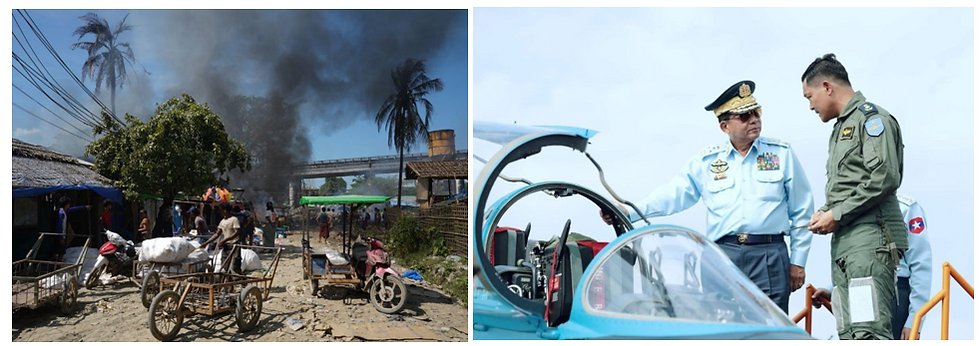
For India, stronger connections with Myanmar can support regional cooperation; for communities along the routes, the important question is whether these projects can translate into accessible opportunities, improved livelihoods, and more sustained interaction across borders. For local communities, constant junta air attacks resulting in the deaths of civilians create increasing challenges and fear along the townships of Kaladan project area near Indian border