_edited.png)


From Refugee Camps to Armed Ecosystems
News Analysis ၊ By Warazein ၊ May 15, 2026
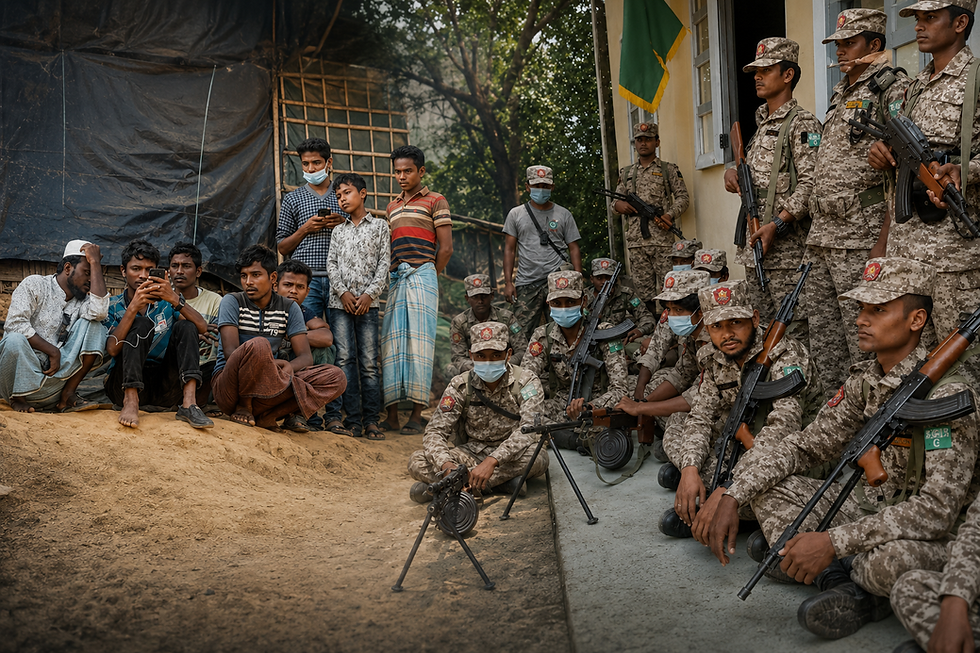
The recent killings inside the Rohingya refugee camps in Cox’s Bazar, followed by formal statements and counter-accusations by armed Rohingya organizations, should serve as yet another warning that parts of the camps have evolved far beyond purely humanitarian spaces. What was once presented primarily as a refugee crisis has, over time, developed into a far more dangerous and complex political-security environment involving armed factions, criminal networks, ideological actors, smugglers, and competing influence structures.
The statement recently issued by the Rohingya Solidarity Organization (RSO), denying involvement in the killings of Abdul Halim and Rustom Kamal, is significant not necessarily because it proves innocence or guilt, but because it highlights the extent to which organized armed and political actors now operate openly inside the camps. The existence of rival factions capable of issuing formal statements, engaging in propaganda battles, mobilizing supporters, and allegedly carrying out targeted attacks demonstrates that the camps are no longer functioning solely as humanitarian shelters.

Over the past several years, reports by international organizations, local media outlets, and independent observers have documented an increasingly alarming pattern of criminality and militarization inside the camps. Kidnappings for ransom, extortion, targeted killings, intimidation of civilians, narcotics trafficking, arms smuggling, and forced recruitment have become recurring features of camp life. Armed groups and criminal networks have repeatedly exploited the lawlessness and desperation that inevitably emerge in large, protracted refugee settlements with limited economic opportunities and weak governance structures.
The situation deteriorated further during the escalation of conflict in northern Arakan in 2024. As the Arakan Army (AA) intensified offensives in Buthidaung and Maungdaw townships, the Myanmar military reportedly accelerated the recruitment of Rohingya youths, in some cases forcibly, to reinforce collapsing frontline positions. Human Rights Watch and other organizations documented forced recruitment practices and the involvement of Rohingya armed elements aligned with the junta. At the same time, competing narratives and disinformation campaigns proliferated across social media, often using unverified or selectively presented material to shape international perceptions of events on the ground.

It is also important to acknowledge an uncomfortable reality: some abuses and violations were committed by multiple actors during the fighting. No serious analysis should deny this. However, broad narratives that simplistically assign collective blame to one side while ignoring the role of armed Rohingya factions, junta-aligned militias, criminal intermediaries, and disinformation networks do not contribute to accountability or reconciliation. Instead, they deepen mistrust and further polarize an already traumatized population.
Equally concerning is the apparent inability—or unwillingness—of the existing security environment to prevent the entrenchment of armed and criminal ecosystems inside the camps. If armed groups were repeatedly able to recruit fighters, move weapons, extort civilians, conduct assassinations, issue political statements, and even launch cross-border operations, it becomes increasingly difficult to argue that the relevant authorities were entirely unaware of these developments. Whether through institutional incapacity, selective tolerance, fragmented oversight, or tactical calculations by different actors, the result has been the same: the camps have become progressively militarized and unstable.
This evolution carries serious implications not only for Bangladesh, but also for Arakan and the wider region. First, the militarization of the camps creates continuous risks of cross-border violence, smuggling, radicalization, and criminal expansion. Second, it significantly complicates any future repatriation process. Repatriation is no longer merely a logistical or humanitarian issue involving shelter and transportation; it now intersects with security concerns, armed networks, ideological hardliners, and fragmented authority structures inside the camps. Third, prolonged instability creates opportunities for various actors—criminal, political, and geopolitical—to exploit the crisis for their own interests.
At the same time, it would be both inaccurate and unjust to conflate ordinary Rohingya refugees with armed groups or criminal actors. The overwhelming majority of refugees remain civilians trapped in extraordinarily difficult conditions, many of whom simply seek safety, dignity, and the opportunity to rebuild their lives. Any sustainable approach must therefore distinguish clearly between vulnerable civilian populations and those who exploit the camps for violent or criminal purposes.
What is urgently needed now is a more realistic and security-conscious approach to the refugee crisis. That includes stronger rule of law inside the camps, transparent investigations into armed activity and targeted killings, tighter control over weapons and trafficking networks, improved cross-border coordination, and greater international recognition that prolonged refugee crises can gradually transform into hybrid political-security environments if left unmanaged.
Ultimately, the danger is no longer confined to isolated incidents of violence. The greater danger lies in allowing refugee camps to evolve into permanent armed ecosystems operating in the shadows of weak governance, competing political agendas, and unresolved regional conflict. Ignoring this reality will only make future stabilization, reconciliation, and repatriation far more difficult for all sides involved.


