_edited.png)


Arakan Government Removing Encroaching Shops and Structures in Ancient Capital Mrauk-U for Road Safety and Urban Beautification
News
Global Arakan Network December 3, 2025
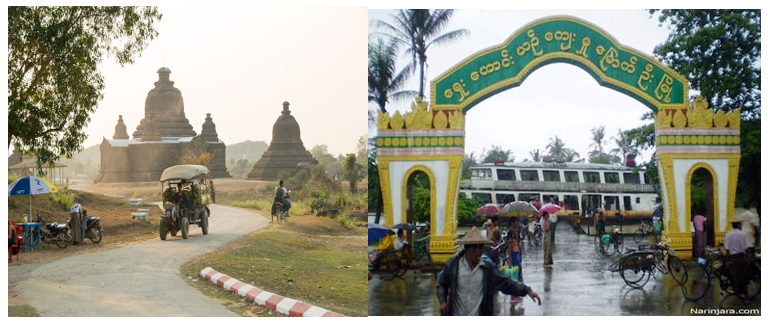
The Arakan People's Revolutionary Government is currently removing shops, attached extensions (ayats), roadside stalls, and other structures that have been built beyond the designated road boundaries of roads in Mrauk-U, the ancient former capital of Rakhine State, in order to ensure traffic safety and make the town cleaner and more beautiful, according to investigations by AB News.
The newly designated road widths are:
70 feet for the Asia Highway (main road)
35 feet for roads inside the town.
The road boundaries have been set to include both sides up to the existing drainage ditches. Any shops, houses, or extensions built beyond the ditches (encroaching onto public road space) must also be removed, a local resident from Mrauk-U told AB News.
“It’s not about expanding the roads or creating new boundaries. They’re just restoring the original road area that existed before — up to the drainage ditches on both sides. Anything built past the ditches will have to be removed. Buildings that don’t cross the ditches probably won’t be affected,” the source said.
During the military council (SAC era, due to widespread bribery among its officials, many shops, houses, and buildings were illegally permitted inside official road reserves in Mrauk-U. As a result, roads gradually became narrower, causing frequent traffic congestion and accidents, according to a 50-year-old local resident.
“When we were young, the roads were really wide. There weren’t many houses or shops built inside the road reserve. But later, during the military council period, municipal officers and land records officials took bribes and allowed people to build shops and houses right inside the road area. So the roads kept getting narrower, extensions kept increasing, and when roads are narrow, traffic jams and accidents became very common. As a town resident, I personally welcome this cleanup effort,” he said.
A 40-year-old woman whose shop or house is affected said that most owners had legally purchased their plots with proper land documents issued during the military council period and have been paying taxes to the current Arakan Army tax department.
“We bought these plots long ago with proper land documents. They are not illegal plots. We have already paid taxes to the AA tax offices,” she said.
Currently, the Arakan People's Revolutionary Government has issued written notices to owners of shops and buildings encroaching on road reserves, asking them to voluntarily to clear the public road space.
The government’s notice includes the following rules:
No houses, shops, or structures may encroach on municipal land, religious land, archaeological zones, public land, or any land under government management.
No signboards, storage of goods, street vending, or vehicle repair is allowed within the road reserve.
No construction or selling activities are permitted beyond drainage channels or platforms.
No new construction or extension of any building is allowed without permission from the relevant authority.
Parking or repairing vehicles in a way that blocks the road is prohibited.
Failure to comply will result in strict enforcement action, the notice states.
On the other hand, an internally displaced person (IDP) affected by the removals said that alternative land should be provided to those who lose their homes or businesses.
“In times like this, almost everyone is struggling. For us war-displaced people, it’s even worse — we live hand-to-mouth. The little money we brought when fleeing the fighting was used to build these small houses, and now if they fall inside road or archaeological zones they will be demolished. So where are we supposed to go? If demolition really happens, we want the authorities to give us separate alternative places to live,” he said.
source@arakanbaynews


