


Arakan State is Renamed Rakhine State
Updated: Oct 27
On This Day in Arakan History ၊ June 18, 1989
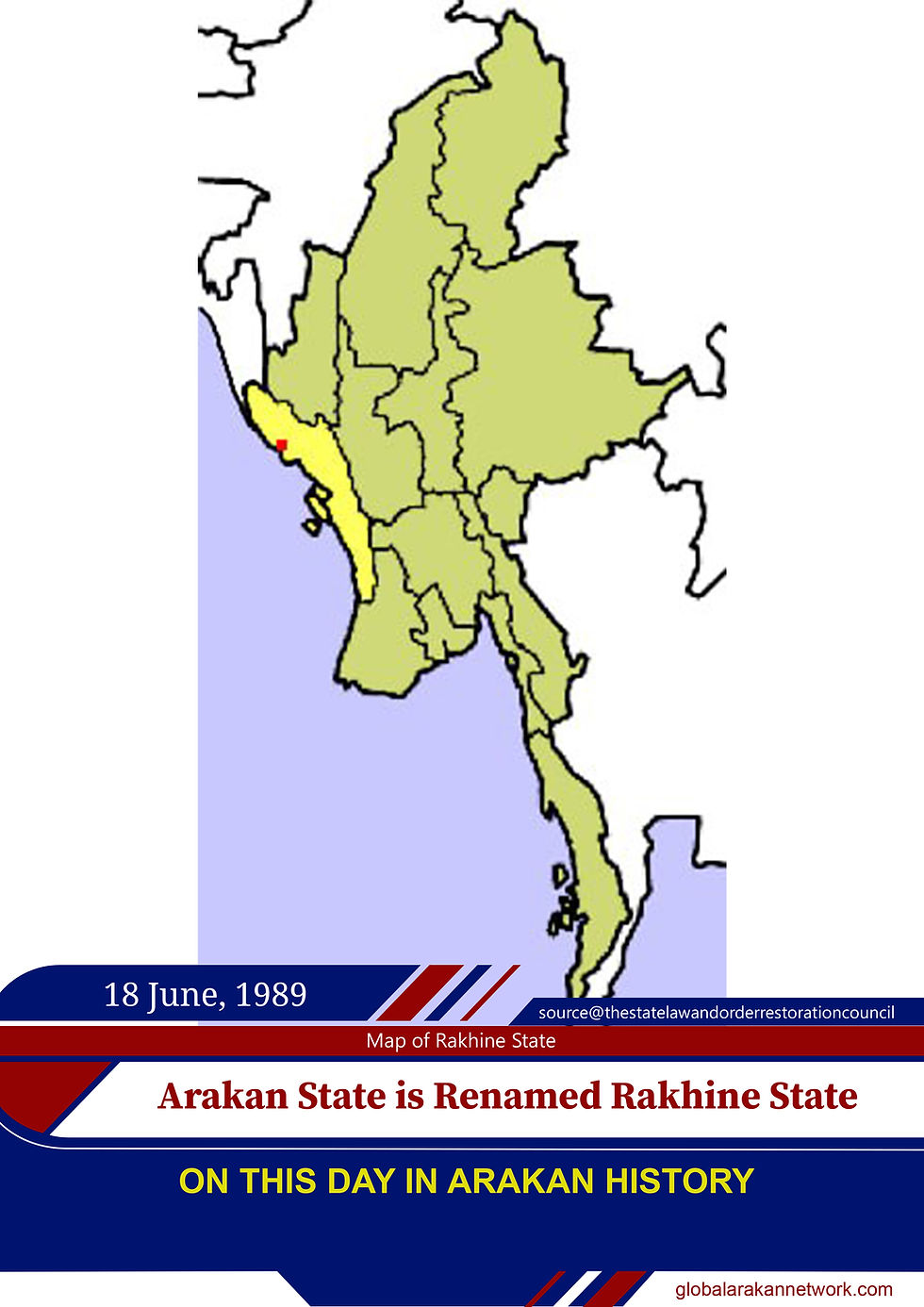
On June 18, 1989, Myanmar’s military government, the State Law and Order Restoration Council (SLORC), enacted the Adaptation of Expressions Law (Law No. 15/89). The law changed the English names of several states, divisions, cities, and geographical features across the country. Among these changes, “Arakan” was replaced with “Rakhine” in the official English name of the state, while Akyab was renamed Sittwe in English. The change formed part of a wider government policy to revise the English spellings of place names to reflect Burmese pronunciation.
The renaming took place under military rule following the suppression of the nationwide pro-democracy uprising in 1988. The SLORC government had seized power in September of that year and sought to strengthen its control over the country’s political and administrative systems. In June 1989, it also changed the country’s official English name from Burma to the Union of Myanmar and revised the English names of other places, including Rangoon to Yangon and Tenasserim to Tanintharyi.
However, the change from Arakan to Rakhine carried particular historical and political significance for the Arakanese people. Arakan is the historical name associated with the region’s ancient kingdoms, political traditions, and cultural identity. The name had been used for centuries and appeared widely in historical records, maps, and political discussions. For many Arakanese, it represents more than a geographical designation; it connects the present population with a distinct historical homeland and its political heritage.
The 1989 change was introduced through a decree of the military government rather than through a public consultation specifically addressing the wishes of the local population. Although the authorities presented the broader naming changes as an adjustment to Burmese pronunciation, the replacement of Arakan with Rakhine became a subject of political debate. Critics viewed the change as part of a wider process through which the central state determined how ethnic territories and identities should be officially represented.
It is important to distinguish the official English renaming in 1989 from the earlier use of the term “Rakhine.” The word had appeared in official usage before June 1989, including in the final version of the 1982 Citizenship Law. Therefore, June 18, 1989, should be understood as the date on which the military government formally changed the English name of Arakan State to Rakhine State under its broader place-name policy, rather than the first time the term “Rakhine” appeared in official documents.
The renaming did not erase the historical use of the name Arakan. The term has continued to appear in historical scholarship, political discussions, and the activities of Arakanese organizations. In contemporary politics, the continued use of “Arakan” expresses a connection to the region’s historical identity and reflects ongoing debates about national identity, self-determination, and the political future of the territory.
June 18, 1989, therefore, marks an important date in modern Arakan history. The official replacement of Arakan with Rakhine in English was part of a nationwide naming policy, but its significance extended beyond spelling and administration. It remains a reminder that place names are closely connected to historical memory, collective identity, and the question of who has the authority to define a people’s homeland.
References
Online Burma/Myanmar Library, The Adaptation of Expressions Law — SLORC Law 15/89. https://www.burmalibrary.org/en/category/burmamyanmar-laws-decrees-and-regulations-state-law-and-order-restoration-council-1989
Network Myanmar, “Some Comments on ‘Myanmar’s “Rohingya” Conflict’.” https://www.networkmyanmar.org/ESW/Files/Commentary.pdf
UK Government, Myanmar (Burma): Toponymic Factfile. https://assets.publishing.service.gov.uk/media/654d01595d60950011bec8b7/Myanmar__Burma__factfile.pdf


